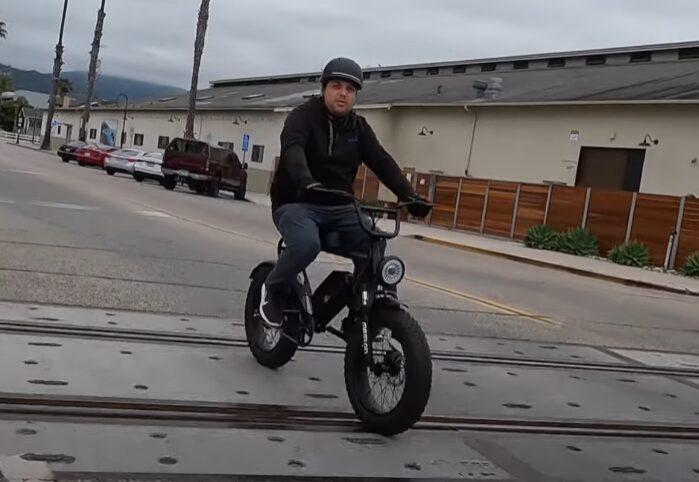
If you have spent any time on a California bike path lately, you have probably seen them: bikes that look less like a Schwinn and more like a 1970s Honda motorcycle. These “moped-style” ebikes became the darlings of the pandemic era, promising high speeds, throttle-heavy riding, and a “cool factor” that traditional commuters just couldn’t touch.
But as we roll into 2026, the party is being broken up by the police.
California has passed a wave of new laws (AB 875, SB 1271, and AB 1774) that effectively pave over the “grey area” these bikes used to park in. If you are riding a bike that looks like a motorcycle and performs like a motorcycle, the state of California is no longer going to take your word for it that it is “just a bicycle.”
Here is the truth about the legal state of moped-style ebikes in 2026 and why the category is currently fighting for its life.
California Ebike Laws in 2026 Changed the Rules for Moped-Style Ebikes
For years, manufacturers exploited a loophole: as long as a bike had pedals and was shipped with a 20 mph speed limit, it was technically an ebike. It did not matter if you could “unlock” 40 mph via an app five minutes after unboxing it.
In early 2026, that loophole was welded shut.
AB 875 and California’s New Ebike Impound Rules
This is the big one. Starting January 1, 2026, California police can remove certain electric vehicles with fewer than four wheels if they do not qualify as legal e-bikes and are being operated without the required license. The law also applies to Class 3 e-bikes operated by riders under 16. In some cases, the vehicle may be held for at least 48 hours before release conditions are met.
If your bike can go over 20 mph on throttle alone, or if the motor is rated over 750W, it likely no longer qualifies as a legal electric bicycle in California and may fall into a different motor-vehicle category.
How does this affect riders under 16 years of age?
Class 2 ebikes are restricted to a maximum speed of 20 mph regardless of how they’re operated — whether using pedal assist or throttle alone. In California, no license is required to ride a Class 2 ebike, which means even a moped-style ebike is legal to ride for anyone under 16, provided it’s classified as Class 2.
AB 1774 and the Ban on Speed-Modifying Ebike Devices
You know those “off-road modes” that let you hit 35 mph with a single tap in an app? Those are now illegal to sell or even advertise in California. The law now prohibits the sale of any device or software designed to modify an ebike’s speed beyond legal limits. If the bike is “easily modifiable,” it is a legal liability for the brand and a target for the police.
Why Super73 Is at the Center of California’s Moped-Style Ebike Debate
We cannot talk about this category without mentioning the brand that started it all. Super73 is currently staring down a massive class-action lawsuit in California. The allegation? They sold “motorcycles masquerading as ebikes.”
The lawsuit claims that by marketing bikes that could be unlocked to reach speeds of 38 mph, the company knowingly put illegal vehicles in the hands of unlicensed riders (often teenagers). This is exactly the kind of heat that is causing the moped-style market to evaporate. When the “top dog” in the industry is in a legal dogfight over its core design, it is a sign that the “moped-as-a-bicycle” era is ending.
Why Some Moped-Style Ebike Brands Are Struggling in 2026
It turns out that pouring resources into over-engineered bicycles is a fast track to financial trouble. This entire category is currently on very shaky ground.
What Happened to Sondors and Juiced Bikes
Two of the biggest names in the game, Sondors and Juiced Bikes, flew a little too close to the sun and have famously imploded.
- Sondors: After a messy bankruptcy, they’ve become a ghost brand. Buying a used Sondors today is a massive gamble… if the controller fries, you’re looking for parts on eBay like you’re restoring a 1950s tractor.
- Juiced Bikes: Once famous for the HyperScorpion (which was basically a light electric motorcycle), the brand folded under the weight of its own complexity. While their assets were bought up, “legacy” owners are finding it impossible to find certified replacement batteries.
If you own a “legacy” Juiced or Sondors bike, you are essentially riding a piece of garage art. Since their batteries are not UL-certified to 2026 standards, you cannot legally buy a replacement in California. If your motor or controller fries, there is no “Gen 1” support. You are on your own.
How to Tell if a Moped-Style Ebike Is Legal in California
If you are shopping for a moped-style bike in 2026, you need to be a detective. If the sales page mentions any of these features, you may be looking at a bike that does not clearly fit California’s legal e-bike rules:
- “Off-Road Mode Unlock”: If it can go 20+ mph, it is not a bike.
- 1000W+ Nominal Motors: California limits electric bicycles to motors of no more than 750W. Anything higher may place the bike in a different legal category with different licensing, registration, and equipment requirements.
- Throttle on Class 3: In California, Class 3 bikes (28 mph) must be pedal-assist only. If it has a throttle and goes 28 mph, it is illegal in the bike lane.
Best Legal Alternatives to Moped-Style Ebikes in California
If you love the moped look but do not want to explain to a judge why your “bicycle” has a 3000W peak motor, there are still a few safe bets.
Super73 (Z-Series and ZX Core)
Super73 is the brand most under fire, but they’ve also been the quickest to pivot. Their Z-series, specifically the ZX Core, is designed to be a “civilian” bike.
- The 2026 Reality: Newer models are locked into Class 2 settings from the factory. If you download their app today, you won’t even see an “Unlimited Mode” option. It’s a 600W nominal motor that keeps you at 20 mph, which is exactly what a California Ranger wants to see.
- Best For: Riders who want the “OG” moped look but realize that 20 mph is plenty for a bike path.
Pedal Electric H/T
While other brands were trying to see how fast they could go, Pedal Electric leaned into being the “responsible adult” of the moto-style world. The H/T is a masterclass in compliance. It’s built like a tank but stays strictly within the 750W/20mph Class 2 limits.
- Why it works: It feels like a motorcycle, but the motor tuning is incredibly smooth and predictable. It is one of the few moped-style ebikes built to feel compliant, predictable, and clearly within California’s Class 2 limits.
Lectric XP4 and Aventon Aventure.2
If you can move past the “Cafe Racer” seat, bikes like the Lectric XP 4 or Aventon Aventure.2 are the smartest buys in 2026.
- The Trade-off: You lose the cool “motorcycle” frame, but you gain 28 mph (Class 3) legality, UL-certified batteries, and, most importantly, a company that will actually answer the phone when you need a spare part.
Specialized Globe Haul ST
Think of this as the “Professional’s Moped.” It has the short wheelbase and fat tires of a moped but the engineering of a high-end cargo bike. It is fully Class 3 (28 mph), has some of the best brakes in the industry, and looks more “utilitarian” than “outlaw,” which generally keeps you off the police radar.
Conclusion: Are Moped-Style Ebikes Still Legal in California in 2026?
Moped-style ebikes are not “illegal” by definition, but the version of them we loved in 2022 (the “go anywhere, go fast, no rules” version) is dead.
Think of it like this: moped-style bikes are the digital equivalent of a mullet. They are business in the pedals, party in the motor, but eventually, the neighbors are going to call the cops. If you want to keep riding in 2026, it is time to choose a bike that respects the rules of the road.
The “wild west” era of ebikes might be in the rearview mirror, but the road ahead still looks great. Stay safe, stay legal, and we will see you out there!
FAQ: California Ebike Laws and Moped-Style Ebikes in 2026
Are moped-style ebikes legal in California in 2026?
Moped-style ebikes are only legal in California if they still meet the state’s definition of an electric bicycle. That means they need fully operable pedals, a motor of no more than 750 watts, and they must fit within California’s legal e-bike classes. If a bike goes beyond those limits, it may no longer qualify as an e-bike under state law.
Do I need a license to ride an ebike in California?
You do not need a license to ride a class 3 ebike but you do need to be at least 16 years old to ride one. Class 2 or Class 1 ebikes are fine for any rider under 16 years of age. Electric bicycles that can reach speeds OVER 28 mph, either on pedal assist mode or using the throttle are no longer classified as ebikes. To summarize, an electric powered bicycle that exceeds 28 mph or has a motor that exceeds 750 watts of power is no longer an ebike in California, it qualifies as an electric motorcycle, which requires a drivers license.
Can police impound an illegal ebike in California?
Yes. Under AB 875, California law allows certain electric vehicles to be removed if they do not qualify as legal e-bikes and are being operated without the required license. The law also applies to Class 3 e-bikes ridden by someone under age 16.
Are 1000W ebikes legal in California?
Not as electric bicycles. In California, an electric bicycle cannot have a motor that exceeds 750 watts. If an ebike has a 1000W motor, it may fall into a different legal category, which can mean different rules for registration, licensing, and rider requirements.
Is a Super73 legal in California?
It depends on the model and how it is configured. A Super73 can be legal if it stays within California’s e-bike rules, but if it is unlocked or modified beyond those limits, it may no longer qualify as an electric bicycle. Super73 has also faced legal scrutiny in California over how some bikes were marketed and configured.
Are speed-unlocking apps or devices legal for ebikes in California?
No, not if they modify the bike so it no longer meets California’s legal definition of an electric bicycle. AB 1774 prohibits the sale of products or devices that increase ebike speed beyond legal limits for public-road use.
Do ebike batteries need UL certification in California in 2026?
For new products sold or leased in California, battery and electrical-system certification rules took effect on January 1, 2026 under SB 1271. The law is focused on product safety standards for new sales and leases, not on forcing current owners to replace existing batteries.
Do I need to replace my old ebike battery in California?
No, the law does not require current owners to replace an old battery just because the standards changed. The bigger issue is that it may become harder to find legal replacement batteries for older systems that do not meet current certification requirements.
Can a 14-year-old ride a moped-style ebike in California?
It depends on the bike’s classification. A rider must be at least 16 years old to operate a Class 3 electric bicycle in California but Class 2 ebikes are still legal for riders under 16 years. If the bike no longer qualifies as an e-bike and falls into another vehicle category, the law now requires you to have a vehicle license.
What makes a moped-style ebike illegal in California?
The biggest red flags are a motor over 750 watts, a throttle that can propel the bike beyond legal limits, or a speed-unlocking feature that pushes the bike outside California’s e-bike classes. A moped-style design alone does not make a bike illegal, but performance and configuration can.
What should I check before buying a moped-style ebike in California?
Check the motor wattage, top assisted speed, throttle behavior, and whether the bike can be easily unlocked through an app or add-on device. You should also check whether the battery and electrical system meet current California sales standards if you are buying a new bike.