Trek is known for lightweight commuters, performance-oriented road bikes, and Bosch-powered mid-drive electric mountain bikes. The Trek Borrego+ is none of those things.
This is an 87-pound, step-through fat-tire ebike with a 750W rear-hub motor, a thumb throttle, and enough cargo capacity for groceries, gear, or even a compatible child seat. It represents Trek’s first entry into a category that has traditionally been dominated by direct-to-consumer ebike brands.
On paper, the Borrego+ follows a familiar formula. After riding it for around 30 miles, however, we came away impressed by how Trek has refined that formula. The ride is exceptionally smooth, the handling is more responsive than its weight suggests, and the entire bike feels stable, comfortable, and well built.
At $2,499.99, the Borrego+ costs more than many competing fat-tire ebikes with larger batteries or similarly powerful motors. What those bikes may not offer is Trek’s established reputation, extensive dealer network, and level of refinement. Whether those advantages justify the premium is the central question of this Trek Borrego+ review.
Quick Verdict
The Trek Borrego+ is a comfortable, capable, and unusually polished fat-tire ebike designed for recreational riding, light off-road adventures, and everyday utility. Its 750W Hyena motor delivers strong acceleration, while its oversized tires, suspension fork, and suspension seatpost create one of the smoothest rides we’ve experienced on a bike this large.
Its biggest compromises are its 87-pound weight, relatively modest 720Wh battery, and premium price. You can find less expensive fat-tire ebikes with bigger batteries, but the Borrego+ is a compelling choice for riders who value ride quality, build quality, and access to local Trek service.
Trek Borrego+ Specifications
Specification | Trek Borrego+ |
Price | |
Bike type | Fat-tire adventure and utility ebike |
Class | Class 2 |
Top assisted speed | 20 mph |
Motor | Hyena rear-hub motor |
Motor output | Up to 750W |
Torque | 90Nm |
Throttle | Left-side thumb throttle |
Battery | 720Wh, removable and lockable |
Claimed range | Up to 70 miles on the current product listing |
Charging time | About 4 hours to 80%; 5.5 hours to 100% |
Weight | Approximately 87 pounds |
Frame | Alloy step-through |
Fork | Coil-spring suspension fork with 80mm of travel |
Tires | Bontrager Borrego 26 x 4-inch, 60 TPI |
Drivetrain | Shimano 8-speed |
Rear derailleur | Shimano Acera M3020-8 |
Brakes | Tektro HD-E3120 hydraulic disc brakes |
Maximum rotor size | 203mm front and rear |
Total weight limit | 440 pounds, including bike, rider, and cargo |
Rear rack capacity | 60 pounds |
Included accessories | MIK HD rack, fenders, lights, brake light, turn signals, and kickstand |
App | Trek Central |
Sizes | Small/Medium and Medium/Large |
Rider height range | Approximately 5 feet 1 inch to 6 feet 6 inches, depending on size |
Trek’s Take on the Fat-Tire Ebike
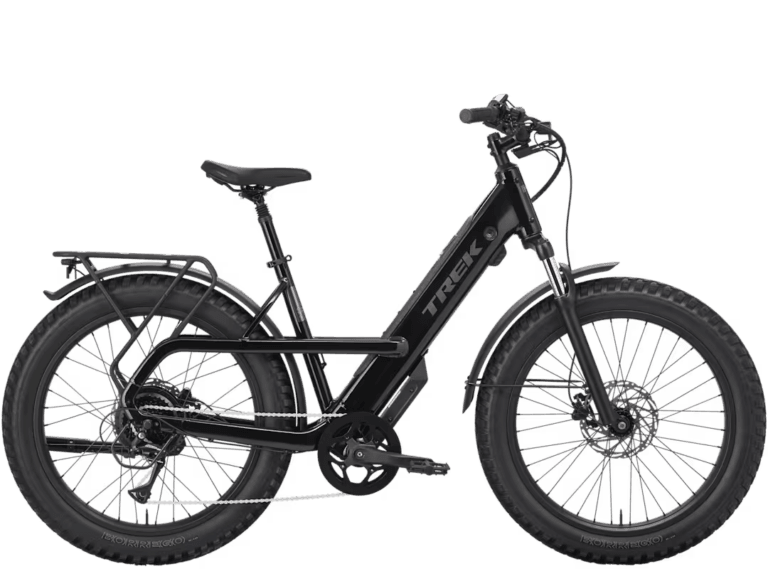
The Borrego+ looks and feels different from the performance-focused electric bikes most riders associate with Trek. Instead of a mid-drive motor working through the bike’s gears, Trek uses a powerful Hyena rear-hub motor with a throttle. Rather than prioritizing low weight and agile trail handling, the Borrego+ emphasizes stability, comfort, and utility.
Its alloy step-through frame makes the bike easier to mount than its size might suggest. The integrated battery keeps the design relatively clean, while the broad tires, substantial rear rack, full fenders, and upright geometry give the Borrego+ a rugged, purposeful appearance.
This is also a beautiful, well-finished ebike. Small touches help distinguish it from more generic fat-tire models, including a convenient strap on the removable battery. It sounds like a minor detail, but it makes an eight-pound battery easier to lift out of the frame and carry inside for charging. It is a practical feature that also adds some visual personality.
The full-color display is bright and easy to read, and the controls include a left-side thumb throttle. Integrated lights, a brake light, and turn signals are all included, so the bike arrives equipped for both recreational riding and practical transportation.
An 87-Pound Ebike That Handles Surprisingly Well
The most pleasant surprise during our testing was how well the Borrego+ handles.
An ebike that weighs 87 pounds and rolls on 26 x 4-inch tires sounds like it should feel slow and cumbersome. Once it is moving, however, the Borrego+ feels stable, balanced, and planted rather than sluggish. Its weight sits comfortably underneath the rider, giving the bike a reassuring sense of control.
That stability makes the Borrego+ well suited to cruising on pavement, gravel paths, and other uneven surfaces. The four-inch Bontrager tires provide plenty of cushioning and traction, while the 80mm suspension fork helps absorb rough pavement and smaller bumps. Trek also includes a suspension seatpost, which is a welcome upgrade on a comfort-focused ebike in this price range.
The result is an impressively smooth ride. The upright position feels relaxed, and the combination of the wide tires, fork, saddle, and suspension seatpost isolates the rider from much of the chatter coming through the road.
This is not a true electric mountain bike, though. Its coil-spring fork, heavy frame, and upright geometry are better suited to gravel, dirt roads, rail trails, and light recreational trails than aggressive singletrack. Think of it as an adventure and utility ebike that can leave the pavement—not as a replacement for Trek’s performance-oriented electric mountain bikes.
Perhaps the biggest surprise was how manageable the Borrego+ felt with the motor turned off. During one ride, we pedaled it without assistance on flat ground and even started up a slight incline before the hill became steep enough to warrant switching the motor back on.
Nobody buys an 87-pound fat-tire ebike because they want to ride it without assistance. Still, it is comforting to know that a depleted battery a mile or two from home would not automatically turn into a roadside disaster.
Powerful Acceleration From the 750W Hyena Motor
The Trek Borrego+ uses a Hyena rear-hub motor with up to 750W of output and 90Nm of torque. Those numbers matter on a bike this heavy, particularly when starting from a stop or carrying cargo.
The motor feels powerful and responsive, and the bike gets up to its 20 mph assisted limit quickly. That immediate thrust is valuable when pulling into a bike lane, crossing an intersection, or getting a loaded bike moving from a stop.
We found the thumb throttle especially useful in these situations. A throttle might be optional on a lighter ebike, but it feels close to essential on a machine weighing nearly 90 pounds. It helps overcome the bike’s mass without requiring the rider to push hard on the pedals while trying to balance at low speed.
The Borrego+ also has enough torque to feel comfortable on hills. We did not perform a formal hill-climbing test with measured grades or times, but the motor provided strong assistance during our rides through rolling terrain.
Once the bike reaches 20 mph, the motor assistance cuts out. Because the motor accelerates so confidently, the transition can initially feel abrupt—as though the Borrego+ has more performance available but is being held back.
There is some wisdom in that limit. Riding at 28 mph on a crowded bike path can be risky on any ebike, particularly one that weighs 87 pounds. Around Santa Barbara, many shared paths are busy enough that even 20 mph can be too fast for the conditions.
Riders who want more speed may prefer the closely related Borrego+ S.
Borrego+ vs. Borrego+ S
The standard Borrego+ is a Class 2 ebike with a throttle and pedal assistance up to 20 mph.
The Borrego+ S combines a throttle that operates up to 20 mph with pedal assistance up to 28 mph, giving it Class 2/3 functionality. Both models otherwise share the same core specifications and $2,499.99 price.
Availability and permitted use can depend on state and local ebike regulations, so confirm which version is sold in your area and where you plan to ride it before purchasing.
Battery Capacity and Real-World Range Expectations
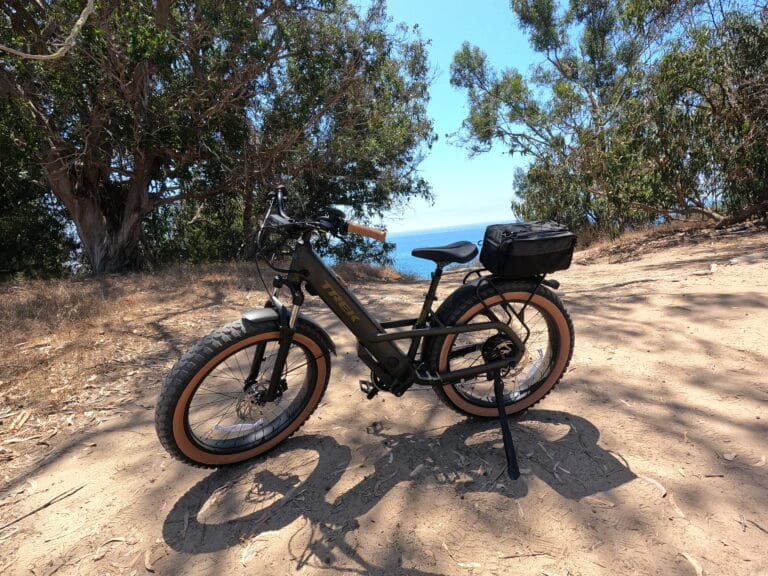
The Borrego+ uses a removable 720Wh battery. Trek’s current product page advertises up to 70 miles of range, although its FAQ lists a slightly lower maximum of 65 miles.
Either figure should be treated as an ideal-condition estimate rather than a guaranteed result. Rider weight, elevation, temperature, cargo, tire pressure, throttle use, and assist level can all make a significant difference.
We rode the Borrego+ for approximately 30 miles but did not conduct a full battery-depletion range test. Based on the bike’s weight and the mixed riding conditions it is designed to handle, riders using higher assistance levels, climbing hills, carrying cargo, or venturing onto unpaved paths should expect considerably less than the maximum claim. A practical expectation could be closer to 35 to 40 miles in more demanding conditions, although actual results will vary.
A 720Wh battery is still a useful amount of capacity. A rider commuting roughly 20 miles each way on a paved route under moderate assistance may be able to complete the round trip on one charge. The criticism is less that the battery is objectively small and more that some less expensive fat-tire ebikes now offer batteries approaching 900Wh or more.
There is no available battery upgrade or range extender for the Borrego+, so buyers cannot add capacity later.
Charging takes approximately four hours to reach 80% and about 5.5 hours to reach a full charge using the included 3A charger. Because the battery can be removed from the top of the frame, you can leave the bike in a garage and carry only the battery inside. Removing it also cuts about eight pounds when lifting or transporting the bike.
Brakes That Match the Bike’s Size
A heavy ebike with a 440-pound total system limit needs serious stopping power. Trek equips the Borrego+ with Tektro HD-E3120 hydraulic disc brakes and support for 203mm rotors at both wheels.
The brakes were one of the standout features during our testing. They feel powerful and controlled, with enough stopping force to bring this substantial bike down from speed confidently. During one ride, a friend had to brake abruptly to avoid a parked car, and the Borrego+ stopped without the situation becoming a crash.
That is not a scientific braking-distance test, but it was a convincing real-world demonstration. Trek did not cut corners on a component that becomes especially important when an 87-pound bike is carrying a rider and cargo.
The Shimano eight-speed drivetrain is another practical inclusion. The M315 shifter, Acera rear derailleur, and 11–34T cassette provide enough gearing to make starts, hills, and lower-speed riding more manageable. The gears are particularly useful if the motor is turned off or the battery runs low.
Built for Cargo and Everyday Utility
The Borrego+ may look like a recreational fat bike, but much of its standard equipment points toward everyday utility.
Its MIK HD rear rack can carry up to 60 pounds and is compatible with panniers, MIK accessories, and approved child-seat setups. Trek also lists the bike as trailer compatible. The total allowable system weight is 440 pounds, including the bike, rider, and cargo.
The standard fenders help keep road spray under control, while the integrated front and rear lights improve visibility. A brake light and turn signals add functionality for riders using the Borrego+ around traffic.
These features give the bike several possible identities. It could serve as a comfortable commuter, grocery hauler, family bike, recreational cruiser, or platform for carrying outdoor gear. It is not a long-tail cargo bike, but it offers considerably more utility than a bare-bones fat-tire ebike.
The wide tires and suspension also make it forgiving on deteriorating streets, gravel roads, and the type of short unpaved detour that can be uncomfortable on a conventional commuter.
The Trek Central App and Digital eLock
The Borrego+ connects to the Trek Central app, which provides battery information, range estimates, ride tracking, route discovery, motor tuning, and software updates.
Its Digital eLock can be controlled through either the app or the bike’s full-color display. The system can also unlock automatically when your phone comes within Bluetooth range.
A digital motor lock should not replace a high-quality physical lock, especially on a $2,500 ebike. It is still a useful additional layer of security and another example of how Trek has gone beyond assembling a motor, battery, and fat tires into a generic frame.
The Biggest Drawback: It Weighs 87 Pounds
There is no getting around it: the Borrego+ is extremely heavy.
This is not an ebike most people will want to carry upstairs, hang on a wall, or routinely lift into the back of an SUV. Many standard hitch-mounted bike racks are not rated to support an 87-pound bike on a single tray, so owners may need a heavy-duty rack and a loading ramp.
Removing the battery reduces the lifting weight by approximately eight pounds, but the remaining bike is still substantial.
For that reason, the Borrego+ is best thought of as a “garage bike.” If you can roll it out of a garage or ground-level storage area whenever you want to ride, the weight becomes much less disruptive. If you live in a second-floor apartment or regularly transport your bike by car, it could become the defining part of the ownership experience.
The weight does bring advantages. It contributes to the bike’s planted handling, substantial cargo capacity, and exceptionally stable ride. The problem is not how the Borrego+ feels once you are riding under power. It is everything you may need to do with it before and after the ride.
Is the Trek Borrego+ Worth $2,499.99?
Price is the Borrego+’s other major consideration.
Direct-to-consumer brands sell fat-tire ebikes with comparable motor output and, in some cases, larger batteries for considerably less. If your buying decision is based primarily on battery capacity, motor wattage, or the lowest possible price, the Borrego+ may not win the comparison.
Trek is selling something less visible on a specification chart: refinement and support.
The Borrego+ feels unusually polished for this category. It rides smoothly, handles better than expected, includes thoughtfully chosen components, and comes from a company with roughly 50 years of experience building bicycles. Trek also has an extensive dealer network, giving buyers the opportunity to test-ride the bike, receive local help, and bring it to an authorized retailer for warranty service or maintenance.
The electric system carries a two-year warranty, with claims handled through authorized Trek retailers.
That support may not matter equally to everyone. Experienced riders who are comfortable assembling, maintaining, and troubleshooting a direct-to-consumer ebike may prefer to put their money toward a bigger battery. Someone who wants a local shop standing behind a very large and expensive electric bike may see the dealer network as one of its most valuable features.
Trek Borrego+ Pros and Cons
Pros
- Exceptionally smooth and stable ride
- Powerful 750W Hyena rear-hub motor with 90Nm of torque
- Useful thumb throttle for starts, hills, and heavy loads
- Strong Tektro hydraulic disc brakes
- Comfortable upright position
- Four-inch tires, front suspension, and a suspension seatpost
- Surprisingly manageable handling for an 87-pound bike
- 60-pound MIK HD rear rack
- High 440-pound total system limit
- Fenders, lights, brake light, turn signals, and kickstand included
- Removable battery with a convenient carrying strap
- Trek Central app and Digital eLock
- Access to Trek’s dealer and service network
Cons
- Extremely heavy and difficult to transport
- More expensive than many direct-to-consumer fat-tire ebikes
- Some cheaper competitors offer larger batteries
- No battery upgrade or range-extender option
- The standard Borrego+ is limited to 20 mph
- Better suited to light trails than serious mountain biking
Who Should Buy the Trek Borrego+?
The Borrego+ makes the most sense for an adventurous or utility-focused rider who wants a powerful fat-tire ebike but is reluctant to buy from a lesser-known online brand.
It is particularly well suited to:
- Recreational riders who prioritize comfort and stability
- Riders who encounter hills or want strong acceleration
- People carrying groceries, outdoor gear, or other cargo
- Parents who want a compatible rack-mounted child-seat setup
- Riders exploring pavement, gravel, dirt roads, and light trails
- Buyers who value local test rides, service, and warranty support
- Riders with a garage or another ground-level storage space
It is less suitable for apartment dwellers, riders who frequently lift their bikes, serious mountain bikers, and buyers focused on maximizing battery capacity for every dollar spent.
Final Verdict
The Trek Borrego+ does not reinvent the fat-tire ebike. Instead, Trek takes a proven combination of big tires, a powerful rear-hub motor, a throttle, and practical accessories and makes the entire package feel more refined.
Its smooth ride and balanced handling were the highlights of our testing. The 750W motor has enough power to move the bike confidently, the brakes are appropriately strong, and the included rack, fenders, lighting, suspension seatpost, and connected features make it useful beyond recreational riding.
We would have liked a larger battery at this price, and the 87-pound weight creates real storage and transportation challenges. Those are meaningful compromises, particularly when less expensive competitors offer impressive specifications.
But buying an ebike is about more than comparing watt-hours and motor output. For riders who want a capable fat-tire ebike backed by Trek’s reputation and dealer network, the Borrego+ makes a strong case for spending more. Trek’s first fat-tire ebike may have taken a while to arrive, but after riding it, we think it was worth the wait.
Trek Borrego+ FAQ
How fast does the Trek Borrego+ go?
The standard Trek Borrego+ is a Class 2 ebike with pedal assistance and throttle operation up to 20 mph. The Borrego+ S provides pedal assistance up to 28 mph while retaining throttle operation up to 20 mph.
How much does the Trek Borrego+ weigh?
The Borrego+ weighs approximately 87 pounds with its battery installed. Removing the battery saves about eight pounds, but the bike is still too heavy for many standard bike racks and may be difficult for one person to lift.
What is the range of the Trek Borrego+?
Trek’s current product listing advertises up to 70 miles of range, while its FAQ lists up to 65 miles. Those are maximum estimates. Hills, rider weight, cargo, temperature, throttle use, and higher assist settings will reduce real-world range.
Can the Trek Borrego+ be used for mountain biking?
The Borrego+ can handle gravel, dirt roads, uneven paths, and light recreational trails. Its 80mm coil fork, upright geometry, and heavy weight make it less appropriate for aggressive mountain biking or technical singletrack.
Can the Trek Borrego+ carry cargo or a child seat?
The standard MIK HD rear rack is rated for up to 60 pounds and is compatible with approved accessories and child-seat configurations. The complete bike, rider, and cargo must remain within the 440-pound total system limit.
Is the Trek Borrego+ worth the price?
The Borrego+ is worth considering if ride refinement, included equipment, and access to Trek’s dealer network are priorities. Budget-focused riders can find less expensive fat-tire ebikes with comparable motor power or larger batteries, but they may not offer the same local sales and service support.