

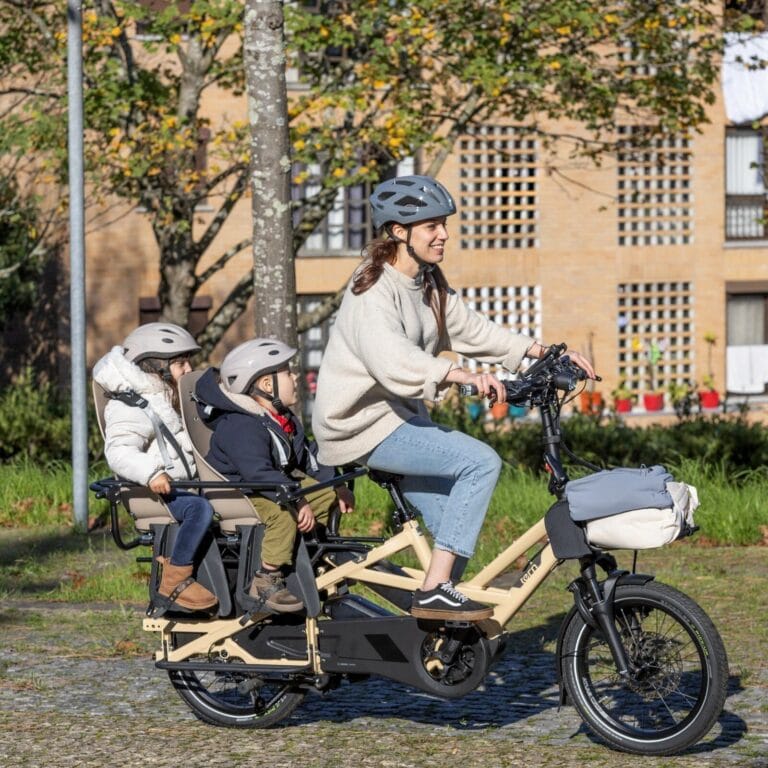
Most people start their ebike search the same way: spec sheets. Motor wattage, battery size, top speed, price. It’s the equivalent of only comparing horsepower numbers when you’re shopping for a car.
And to be fair, that works fine if you’re buying something for the occasional weekend cruise.
But the moment you start looking for a bike that might replace actual car trips, those numbers stop telling the whole story. Hauling cargo, kids, backpacks, and groceries through unpredictable city streets is a completely different job than cruising a park path on Sunday.
That’s where Tern ebikes enter the conversation.
Why Tern Ebikes Are Different From Other Electric Bikes
Tern doesn’t really do trendy bikes. They build machines that are meant to work. These things are engineered to be urban workhorses, the kind of bikes that carry your most precious cargo (usually your kids) through chaotic traffic and uneven streets every single day without falling apart.
In other words, Tern bikes are less like recreational bicycles and more like two-wheeled minivans.
That focus on real-world utility is exactly why Tern has built such a hardcore reputation for safety and reliability. It’s also why their bikes cost noticeably more than many of the direct-to-consumer brands flooding the internet.
This guide breaks down the entire Tern lineup, explains how each bike actually behaves in real-world riding, and helps you figure out which model fits your lifestyle, not just which one looks impressive on a spec sheet.
Who Makes Tern Ebikes? Brand History and Philosophy
Tern launched in 2011 with a pretty ambitious goal: build bikes that people could realistically use instead of cars.
That sounds obvious now, but at the time most ebikes were still treated like novelty gadgets or recreational toys. Tern approached things from a completely different angle.
From day one, the company focused on urban mobility. Commuting. Errands. Family logistics. The unglamorous daily tasks that normally require a car.
The brand was founded in Taiwan by Florence Shen and Joshua Hon, both of whom already had deep experience in folding bikes and urban cycling. Instead of chasing flashy performance numbers or weird experimental designs, Tern leaned heavily into practical engineering.
The result is a lineup of bikes that feel intentionally designed around real life.
You’ll see things like:
- extremely stable cargo frames
- racks designed for actual passengers
- motors tuned for hauling weight safely
- accessories that make daily riding easier
It’s not the most glamorous approach to bike design, but it’s a big reason why Tern has become one of the most trusted names in the cargo ebike world.
Why Tern Ebikes Cost More Than Other Ebikes
If you’ve looked at Tern bikes before, maybe the first thing you noticed was the price.
Compared to many direct-to-consumer ebike brands, Tern bikes can cost significantly more. But once you look closer at how they’re built, the reasoning becomes pretty clear.
Three things drive most of that price difference.
Bosch Mid-Drive Motors
Every modern Tern ebike uses Bosch mid-drive motor systems, which are widely considered the gold standard in the industry.
Bosch motors are known for a few things riders immediately notice:
- smooth pedal assistance
- extremely predictable power delivery
- strong torque at low speeds
- long-term reliability
- global service support
That last one matters more than people realize. When something eventually needs maintenance (and every bike eventually does) Bosch systems can be serviced at thousands of shops worldwide. Many cheaper motors don’t have anything close to that support network.
Cargo models like the Tern GSD use Bosch Cargo Line motors, which are specifically tuned for hauling a lot of weight safely. Instead of blasting power all at once, the motor ramps up gradually. That’s important when you’re starting from a stoplight with a kid and a backpack full of snacks on the back of the bike.
Load-Certified Frames
One of the biggest differences between Tern and many cheaper cargo bikes is how seriously the company takes load ratings.
Tern bikes go through extensive stress testing to verify that the frame can handle heavy cargo safely over long periods of time.
For example, the Tern GSD has a gross vehicle weight rating of about 463 pounds. That number includes the rider, passengers, cargo, and the bike itself.
More importantly, the racks are actually engineered to carry passengers, not just marketed that way. A lot of cheaper bikes advertise cargo capability but use racks that were originally designed to hold a backpack and maybe a grocery bag.
Components Built to Last
Another place Tern stands out is component quality.
Instead of using the cheapest possible parts, many Tern bikes include components designed to reduce maintenance and improve durability.
Common upgrades include:
- Hydraulic disc brakes with strong modulation
- Internally geared hubs like Enviolo
- Gates carbon belt drives on some models
- Reinforced wheels with higher spoke counts
These parts cost more upfront, but they also tend to last significantly longer… perfect for riders who use their bike every day.

Tern Ebike Spec Comparison Table
Model | Category | Motor | Battery | Weight | Max Load (GVW) | Wheel Size | Drivetrain |
Vektron | Folding | Bosch Performance Line/Bosch Active Line Plus | ~400-545 Wh | 20-21.6kg | ~125 kg | 20 inches | Chain / Belt |
NBD | Utility | Bosch Performance Line/Bosch Active Line Plus | ~400–500 Wh | 23.4-23.7 kg | ~140 | 20 inches | Chain / Belt |
HSD | Compact Cargo | Bosch Performance Line | ~545 Wh | 27.6-28.1 kg | 180 kg | 20 inches | Chain / Belt |
GSD | Full Cargo | Bosch Cargo Line Smart | 500-1600 Wh | 34.64-38.77 kg | 210 kg | 20 inches | Chain / Belt |
Orox | Adventure Cargo | Bosch Performance CX | 725-800 Wh | 34.4-37.7 kg | 210 kg ; 180 kg | 27.5-29 inches | Chain / Belt |
Quick Haul (Long) | Compact Cargo | Bosch Performance Line/Bosch Active Line Plus/Bosch Cargo Line | 400 Wh | 22.8-29.3 kg | 150-190 kg | 20 inches | Chain |
Tern Ebike Models Explained
Tern’s lineup looks complicated at first, but each bike actually solves a very specific problem. Here’s the quick way to think about them.
Bike | What It’s Best At | Who It’s For |
Vektron | Folding commuter performance | Apartment dwellers and transit riders |
NBD | Maximum stability and approachability | Comfort-first riders and beginners |
Quick Haul | Lightweight everyday utility | Commuters running errands |
HSD | Compact cargo hauling | Urban riders carrying gear or kids |
GSD | Full cargo car replacement | Families and heavy daily hauling |
Orox | Cargo across rough terrain | Riders outside dense cities |
If you think of the Vektron as the space-saving commuter and the GSD as the family minivan, the other bikes fill the space in between.
Tern Vektron: The Folding Ebike That Doesn’t Feel Like a Compromise
Most folding ebikes ride like… well… folding bikes. They tend to feel twitchy, underpowered, and slightly unstable once you get moving.
The Tern Vektron is different because it was built like a real commuter bike first and a folding bike second.
Instead of a rear hub motor, the Vektron uses a Bosch mid-drive system, which keeps the weight centered and the power delivery smooth. The result is a folding bike that climbs hills confidently and accelerates in a predictable way instead of feeling like a scooter bolted onto the back wheel.
That alone makes it one of the most natural-feeling folding ebikes on the market.
Why the Tern Vektron Is One of the Best Folding Ebikes
The biggest advantage of the Vektron isn’t just convenience, it’s access. Full-size ebikes are heavy and awkward to store. If you live in an apartment, bring your bike inside at work, or combine cycling with public transit, that can become a daily headache.
The Vektron solves that problem by folding into a compact package that fits:
- under a desk
- in a hallway closet
- in a car trunk
- next to you on a train or ferry
For many city riders, that flexibility is the difference between owning an ebike and not owning one at all.
Who the Tern Vektron Is Best For
The Vektron isn’t designed to haul heavy cargo like the HSD or GSD. Think of it more as a space-saving commuter tool.
It’s ideal for riders who:
- live in apartments
- combine biking with public transit
- want a powerful commuter that stores easily
If storage space is your biggest constraint, the Vektron solves that problem without sacrificing ride quality.
Tern Vektron Quick Specs
- Motor: Bosch Active Line, 36 V/250 W, max torque 40 Nm
- Battery: Bosch PowerPack 400 Wh
- Range: 50-130 km (30-80 mi)
- Top Speed: 20 mph (US)
- Brakes: Shimano, hydraulic disc
- Shifter: Shimano Alivio, 1 x 9 spd, trigger
- Weight: 21.9 kg (48.3 lb)
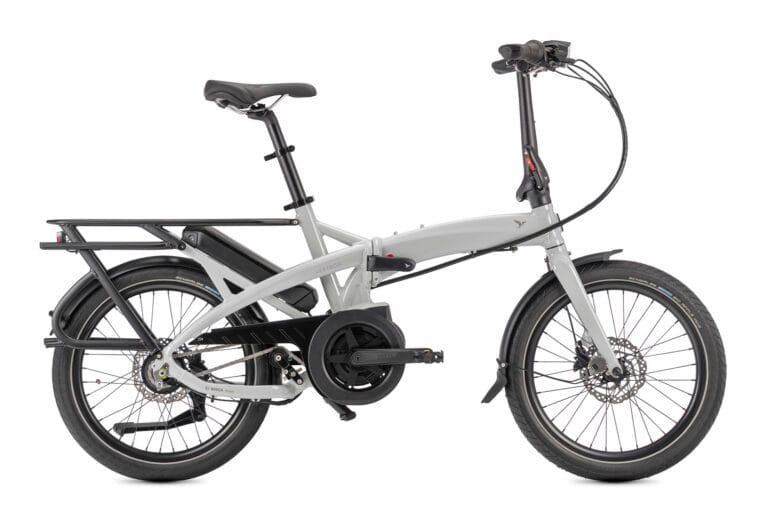
Tern NBD: The Most Stable Step-Through Tern Ebike
At first glance it looks simple. Smaller wheels, a super low frame, and a very upright riding position. But that simplicity is exactly the point. The Tern NBD was designed to remove the things that make many ebikes intimidating in the first place.
The most noticeable feature is the extremely low step-through frame. At just over 15 inches, getting on and off the bike feels effortless. You’re not swinging your leg over a tall seat or wobbly on your tip-toes every time you want to stop.
Combined with the 20-inch wheels, the bike’s center of gravity sits noticeably lower than most commuter bikes. That makes the NBD feel very stable at low speeds, which is where a lot of riders struggle.
Why the Tern NBD Is One of the Easiest Ebikes to Ride
A lot of ebikes can feel heavy and slightly awkward when you’re navigating tight bike lanes or crowded paths. The NBD takes the opposite approach.
Because the bike sits lower and uses smaller wheels, it feels extremely manageable when starting, stopping, or maneuvering through city traffic. That confidence is a huge deal for riders who may be returning to cycling after years away. The riding position also stays very upright, giving riders excellent visibility in urban environments.
Who the Tern NBD Is Best For
The NBD isn’t trying to compete with cargo bikes like the HSD or GSD. Think of it more as a confidence-first city bike.
It’s ideal for riders who:
- prioritize stability over speed
- want a very approachable ebike
- need a low step-through frame
- ride mostly short-to-medium city trips
If the Vektron solves storage problems, the NBD solves confidence problems.
Tern NBD Quick Specs
- Motor: Class 1, Bosch Active Line Plus, 270% Assist, 50 Nm Torque
- Battery: Bosch PowerPack 400
- Range: 54 -108 km (34-67 mi)
- Top Speed: 20 mph (US)
- Brakes: Shimano, hydraulic disc
- Shifter: Shimano 8 spd.
- Weight: 23.7 kg (52.2 lb)
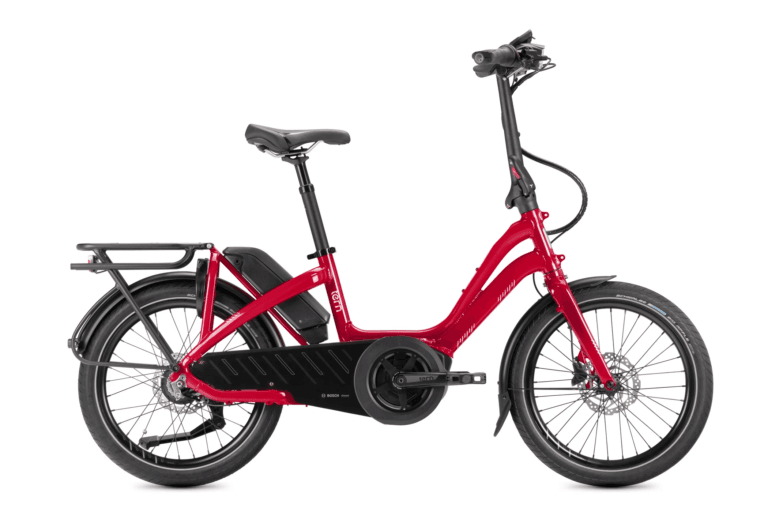
Tern Quick Haul: The Practical Everyday Utility Bike
The Tern Quick Haul exists for riders who want something more capable than a commuter bike but don’t necessarily need a full cargo platform.
That’s exactly where the Quick Haul lives.
It rides and handles much like a normal commuter bike, but it has a reinforced rear rack and frame that make everyday hauling surprisingly easy.
Why the Tern Quick Haul Is a Great Commuter and Utility Ebike
Think of the Quick Haul as a commuter bike that secretly has cargo-bike DNA.
You can comfortably carry things like:
- grocery bags
- panniers and baskets
- work gear
- small cargo loads
But unlike larger cargo bikes, the Quick Haul still feels light and maneuverable in traffic.
There’s also a Quick Haul Long version that stretches the platform slightly to support child seats and heavier loads. It’s essentially the “family friendly” version of the same idea.
Who the Tern Quick Haul Is Best For
The Quick Haul is perfect for riders who want utility without committing to a big cargo bike.
It works well for:
- urban commuters
- grocery runs and errands
- riders upgrading from a normal commuter bike
- people who occasionally carry cargo
Compared to the HSD or GSD, it’s lighter, simpler, and easier to live with day to day.
Tern Quick Haul Quick Specs
- Motor: Bosch Active Line Plus, 270% Assist, 50 Nm Torque
- Battery: Bosch PowerPack 400
- Range: 54 – 105 km (33.6 – 65.2 mi)
- Top Speed: 20 mph (US)
- Brakes: Shimano, hydraulic disc
- Shifter: Shimano Altus, 1 x 8 spd, trigger
- Weight:22.8 kg (50.3 lb)
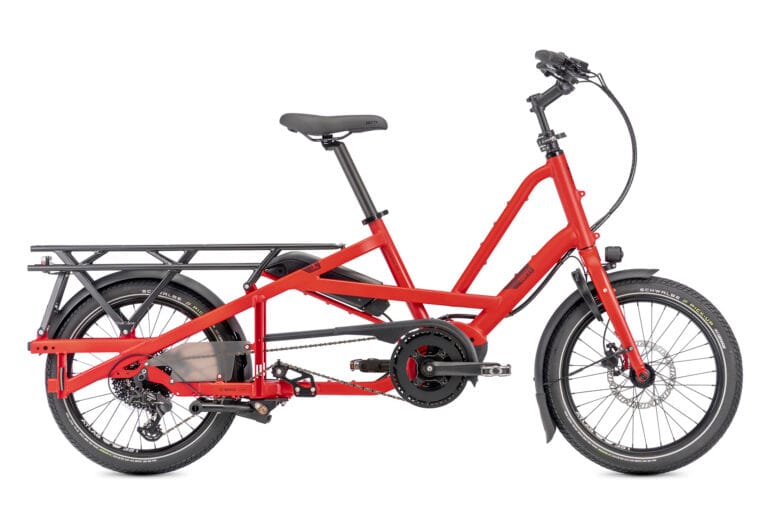
Tern HSD: The Compact Electric Cargo Bike
The Tern HSD is where the lineup starts getting serious about hauling capability.
At first glance, it looks like a slightly oversized commuter bike. However, the moment you start loading the rear rack, it becomes obvious this bike was built for much heavier work. The rack is strong enough to carry large panniers, cargo crates, child seats, and even an adult passenger within rated limits.
That’s a level of capability most commuter bikes simply can’t match.
Why the Tern HSD Is a Popular Compact Cargo Bike
Cargo bikes are incredibly useful, but they’re also big. The HSD tries to capture most of that cargo capability without the size and weight of a full longtail bike like the GSD.
The result is a bike that feels:
- much more nimble in traffic
- easier to park and store
- easier to maneuver in tight spaces
You still get serious hauling ability, but the bike doesn’t feel like you’re driving a small truck through the bike lane.
Who the Tern HSD Is Best For
The HSD is for riders who need cargo capability frequently, but not necessarily all the time.
It’s ideal for:
- commuters who carry gear daily
- parents with one child seat
- riders hauling groceries regularly
- people who want cargo flexibility without full cargo-bike size
It’s basically the utility knife of the Tern lineup.
Tern HSD Quick Specs
- Motor: Bosch Performance Sport, 340% Assist, 75 Nm Torque
- Battery: Bosch PowerPack 545
- Range: 51-121 km (32-76 mi)
- Top Speed: 28 mph (US)
- Brakes: Magura, hydraulic
- Shifter: Shimano Deore, 1 x 11 spd
- Weight: 28.1 kg (61.9 lb)
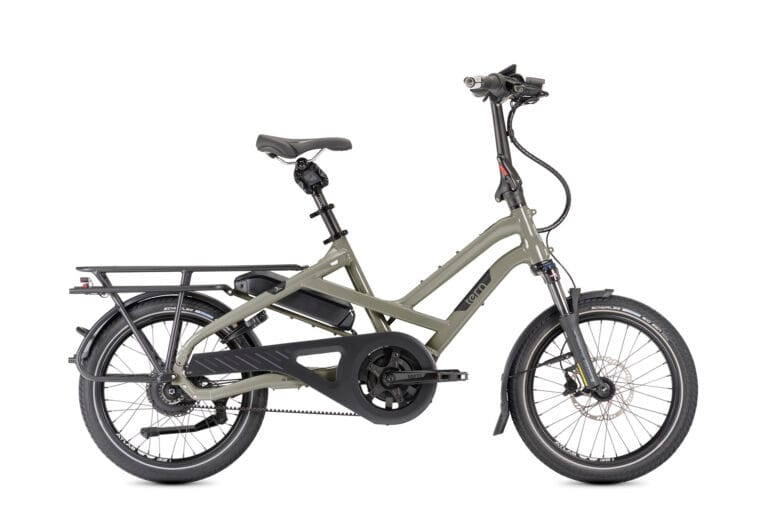
Tern GSD: The Cargo Bike That Replaces Cars
If there’s one bike that defines Tern as a brand, it’s the Tern GSD. This is the bike that made many families realize an ebike could realistically replace a car for daily errands.
The GSD is a full electric cargo bike, capable of carrying up to roughly 463 pounds total weight when you include rider, cargo, passengers, and the bike itself.
That’s a huge number in the bike world.
What It’s Like Owning a Tern GSD Cargo Bike
Families use the GSD for things like:
- school drop-offs
- grocery shopping
- commuting
- hauling sports gear
- running daily errands
With the right accessories, it can even carry two kids on the back comfortably.
The bike’s low center of gravity and Bosch Cargo Line motor keep everything stable even when it’s fully loaded. That’s a big reason parents feel comfortable using it as a transportation tool instead of just a recreational bike.
Why the Tern GSD Is Easier to Ride Than Most Cargo Bikes
Despite its cargo capability, the GSD is surprisingly compact. Tern intentionally designed the bike so it’s roughly the same length as a normal bicycle, which makes it easier to park and maneuver in city environments.
That combination (huge hauling ability with relatively manageable size) is why the GSD has become one of the most popular cargo ebikes in the world.
Tern GSD Quick Specs
- Motor: Bosch Cargo Line, 400% Assist, 85 Nm Torque
- Battery:Bosch 545 PowerPack, Fast Swap, Dual Battery bays, optional 2 x 800 Wh max capacity
- Range: 545 Wh: 45-98 km (28-61 mi); 1090 Wh: 90-196 km (56-122 mi)
- Top Speed: 20 mph (US)
- Brakes: Magura ABS, hydraulic
- Shifter: Shimano Deore, 1 x 10 spd
- Weight:37.32 kg (82.3 lb)
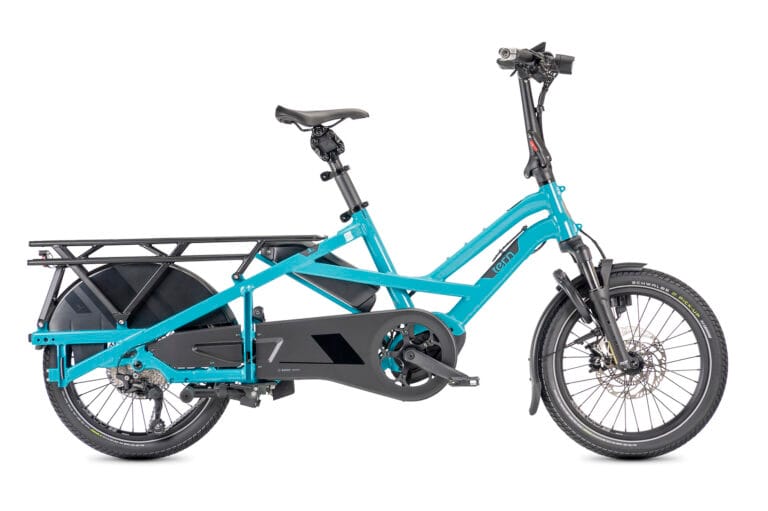
Tern Orox: The All-Terrain Electric Cargo Bike
Most cargo bikes assume you’re riding on smooth city streets. The Tern Orox was built with a completely different assumption: sometimes the road gets rough.
With oversized tires, a reinforced frame, and a powerful Bosch Performance CX motor, the Orox is designed to carry heavy loads across mixed terrain.
That includes things like:
- gravel roads
- forest paths
- snow-packed streets
- cracked pavement
In other words, places where traditional cargo bikes start to struggle.
Why Tern Built the Orox Cargo Bike
Not everyone lives in a dense city with perfect bike lanes. Riders in mountain towns, rural areas, or places with rough infrastructure often need a bike that can handle both cargo and unpredictable terrain.
The Orox fills that role. It’s still capable of carrying serious loads, but the geometry and tires give it the traction and stability needed for rougher conditions.
Who the Tern Orox Is Best For
The Orox is the most adventure-oriented bike Tern makes.
It’s best suited for riders who:
- live outside dense cities
- ride on gravel or mixed terrain
- need cargo capability in rough conditions
- want maximum durability
If the GSD is the urban family hauler, the Orox is the cargo bike for people who don’t stay on pavement.
Tern Orox Quick Specs
- Motor: Bosch Performance CX
- Battery: 725 Wh, Bosch Dual Battery pack ready
- Range: 725 Wh: 84 – 146 km (52 – 91 mi); 1450 Wh: 168 – 292 km (104 – 181 mi)
- Top Speed: 20 mph (US)
- Brakes: Magura, hydraulic
- Shifter: Shimano Deore, 1 x 12 spd
- Weight: 37.1 kg (81.8 lb)
Pros and Cons of Tern Ebikes
As impressive as Tern bikes are, they’re not perfect for everyone.
First, there’s the obvious one: price. Tern bikes sit firmly in the premium category, and that sticker shock can be real if you’re comparing them to direct-to-consumer ebikes online.
They’re also heavier than traditional recreational bikes, which is the tradeoff for frames designed to carry cargo, passengers, and daily gear safely.
Finally, most Tern bikes rely on Bosch mid-drive systems, which means diagnostics and deeper servicing are typically handled through authorized dealers rather than pure DIY repairs.
For riders who only plan to ride occasionally or want the lightest, sportiest ebike possible, Tern may feel like overkill. But for people who plan to ride often, carry real loads, or depend on their bike as transportation, those tradeoffs start to make a lot more sense.
Which Tern Ebike Should You Buy?
If the lineup still feels a little overwhelming, the easiest way to choose is by thinking about what problem you’re trying to solve.
If storage space is your biggest challenge → Vektron
A powerful commuter that folds small enough for apartments, offices, or public transit.
If you want the easiest ebike to ride → NBD
Ultra-low step-through frame and very stable handling make it one of the most approachable bikes in the lineup.
If you want a commuter that can also handle errands → Quick Haul
Feels like a normal city bike but has the strength to carry groceries, bags, and everyday cargo.
If you need serious hauling ability without a massive bike → HSD
Compact cargo capability that still feels manageable in busy city streets.
If you want to replace real car trips → GSD
Built specifically for families, passengers, and heavy daily hauling.
If your riding involves gravel or rough roads → Orox
A cargo bike designed for terrain where most city bikes start to struggle.
Tern doesn’t make dozens of overlapping models. Each bike is designed to solve a specific problem, you just need to figure out which one matches the way you actually ride.

Are Tern Ebikes Worth the Price?
Tern ebikes aren’t cheap, but they aren’t trying to compete with bargain ebikes either.
These bikes are built to replace real car trips and function as daily transportation tools. For riders who value durability, safety, and reliability, that engineering focus can easily justify the higher price.
In short, Tern bikes cost more because they’re designed to work harder, carry more, and keep doing it for a long time.
FAQ: Tern Ebikes
Are Tern ebikes reliable?
Yes. Tern bikes are widely known for their durability, especially in cargo and commuter use.
Can Tern ebikes replace a car?
For many riders, yes. Models like the GSD are designed specifically to replace car trips for families.
Are Tern bikes heavy?
They are heavier than recreational bikes because they prioritize strength and cargo capacity.
Do Tern ebikes use Bosch motors?
Yes. Most modern Tern ebikes use Bosch mid-drive systems.
Are Tern cargo bikes safe for carrying children?
Yes. Models like the GSD and HSD are specifically designed and tested to carry passengers safely.