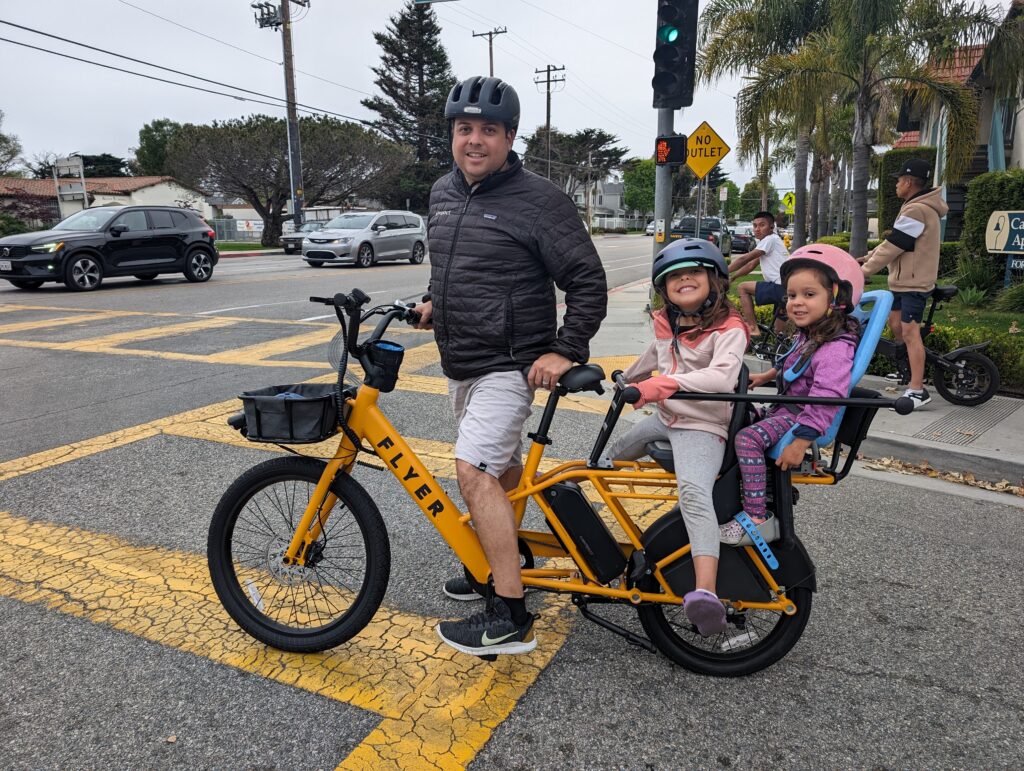
An ebike child seat can turn daycare drop-off, a trip to the park, or a quick errand into something you can do on two wheels. It also puts your favorite tiny person on the same bike you are responsible for steering, stopping, and keeping upright, so this is not a category where “looks secure enough” gets us very far.
The good news is that figuring out whether a setup makes sense is fairly straightforward. Your child needs to be ready to ride, the seat needs to be approved for your specific bike and mounting point, and you need to be comfortable handling the extra weight once they are aboard.
That last part deserves a practice run. A child sitting high on the bike changes the balance, and the extra weight changes how the bike starts, turns, and stops. The American Academy of Pediatrics (AAP) recommends extra caution with young passengers and prefers a bicycle-towed child trailer when that works for the family and bike. HealthyChildren.org
So before you start planning matching helmets and Saturday-morning rides, here is what is worth checking.
When is a child old enough to ride?
For babies, the AAP draws a pretty clear line: under 12 months is too young to ride on a bicycle, whether that means sitting in a rear child seat or riding in a bike trailer.
That recommendation is about more than blowing out a first birthday candle. Once a child is at least 12 months old, the AAP says they should also be able to sit well without support and have enough neck strength to support a lightweight helmet before riding as a passenger. HealthyChildren.org
In other words, one year gets you to the starting line. It does not automatically make every one-year-old ready to ride.
Your child also needs to fit within the seat manufacturer’s age, height, and weight limits. If you are unsure about their development or ability to support a helmet comfortably, that is a question for the pediatrician rather than a judgment call in the garage.
What about trailers that say six months?
This is where the labels can get confusing.
Some convertible child trailers double as strollers and allow younger babies while you are pushing them on foot. That younger age does not necessarily apply once the same trailer is hitched to a bicycle.
Burley’s Honey Bee is a good example: Burley lists stroller use from 6 months but biking from 12 months.
Same trailer. Very different activity.
You may also find bike seats with manufacturer age ranges starting around nine months. That is the seat maker’s product guidance, while the AAP takes the more cautious position of waiting until at least 12 months for bicycle passengers.
For this guide, we would follow the AAP recommendation rather than trying to find the youngest age printed on a box. Thule
Will a child seat fit your ebike safely?
This sounds like it should be a yes-or-no question. However, ebikes (naturally) have found a way to make it more complicated.
A child seat can attach to the bike perfectly well and still be the wrong seat for that bike.
The easiest way to think about compatibility is that three things need to say yes:
- The bike: Your ebike manufacturer allows a child passenger and that type of seat on your specific model.
- The mount: The rack or frame section you are attaching it to meets the seat maker’s requirements.
- The seat: The child seat is approved for both your child and that mounting setup.
Miss any one of those and we would keep shopping.
Why the exact mount matters
This is where product names and rack ratings can start making everyone’s eyes glaze over, so here is the useful part.
Not every rear rack is designed to hold a child seat, even if it can carry plenty of weight. And some child seats require a particular rack system rather than simply “a sturdy rack.”
Take Thule’s Yepp 2 Maxi. The rack-mounted version requires a carrier capable of supporting the combined child-and-seat load. The MIK HD version is more specific: it needs a MIK HD-compatible rack.
So if your bike has a perfectly respectable rear rack that is not MIK HD, the answer is still no for that version of the seat. This is why shopping by “it looks like it should fit” can turn into a very expensive game of return shipping.
Frame-mounted seats have their own version of the same problem. Burley’s Dash FM, for example, fits specific seat-tube shapes and sizes and is not approved for carbon frames or full-suspension bikes.
The point is not that you need a Thule, Burley, or any particular brand. It is that mounting style is part of the compatibility check, not a detail to figure out after the box arrives. Thule
And yes, there can be two different weight limits
A bike may have enough total payload capacity for you and your child while its rear rack does not have enough capacity for the child seat setup.
That is because the numbers are doing different jobs.
Say your rack is rated for 55 pounds. The seat itself weighs 10 pounds and your child weighs 40. You are already at 50 pounds before adding anything else to that rack.
Then there is the bike’s overall load limit, which may count the rider, child, accessories, and cargo depending on how the manufacturer defines it.
Tern’s passenger guidance shows this clearly: its bikes can have one limit for the rear rack and another for the bike as a whole.
So do not stop checking as soon as you find one number that looks comfortably high. Make sure both the mounting point and the whole bike can handle the setup you are building. Tern
If the manuals leave you with more tabs open than answers, send the exact bike, seat, and rack models to the manufacturer or a bike shop and ask them to confirm the combination.
What should you look for in a child seat?
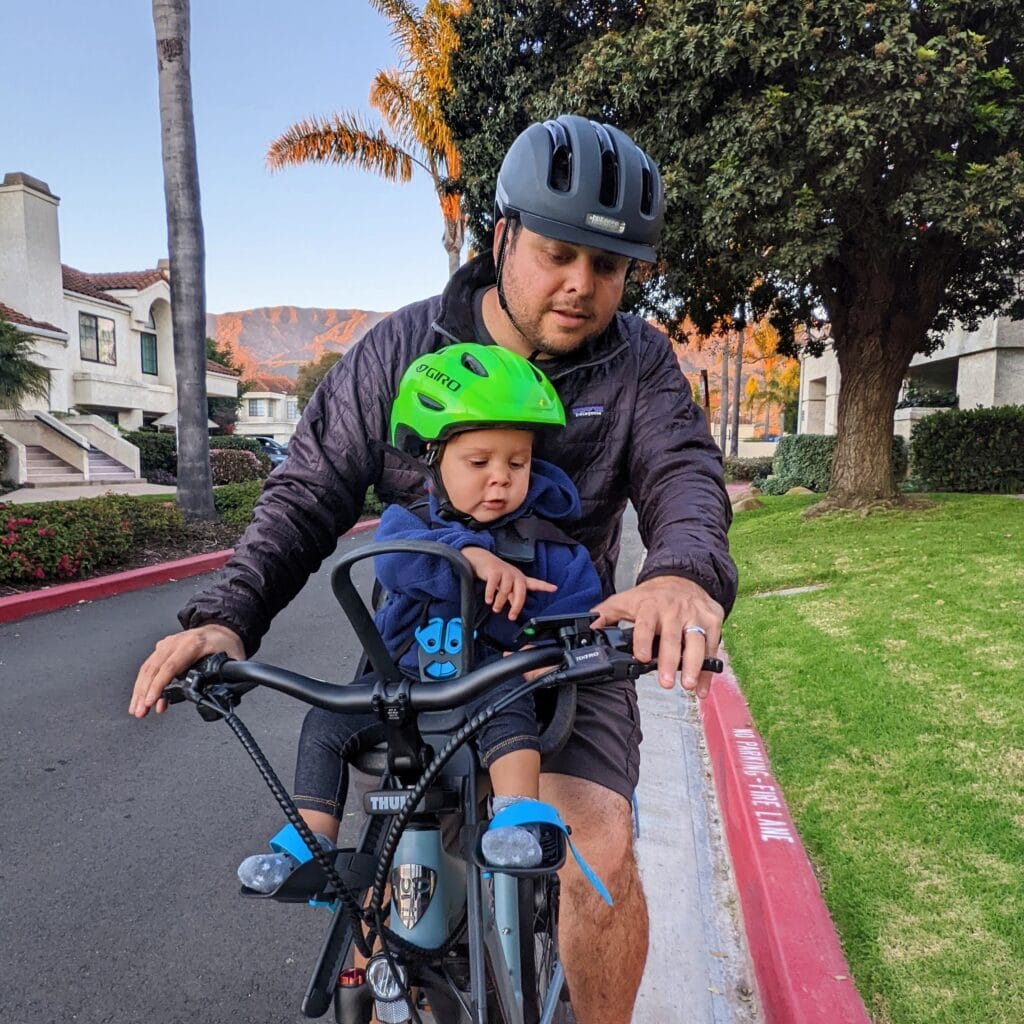
Once compatibility is sorted, the seat has two main jobs: keep your child securely in place and keep small hands, feet, and clothing safely away from the bike’s moving parts.
For a rear-mounted seat, the AAP recommends a high back, sturdy harness, secure mounting over the rear wheel, and protection that keeps hands and feet away from the spokes. The harness should also support a sleeping child. HealthyChildren.org
Anyone who has watched a toddler fall asleep halfway through a snack knows “maintaining a sensible upright posture” is not something we can count on here.
Use the footrests, foot straps, and harness every ride, and adjust them as your child grows.
Check the helmet while your child is in the seat
Helmet fit deserves one extra step that is easy to miss.
Put the helmet on after your child is sitting in the bike seat and look at how the seat back interacts with it. A high back can sometimes push against the helmet and tip it forward, even if everything looked perfectly fine when you tried it on inside.
NHTSA recommends a helmet that fits your child now rather than buying a larger one with room to grow. Kids will give you plenty of other things to replace six months earlier than expected, don’t worry.
The adult rider should wear one too. HealthyChildren.org
Before riding, give the whole setup a quick once-over: make sure the seat is fully attached, the harness and foot straps are secure, the mounting hardware has not loosened, and nothing from the seat or passenger can reach the wheel, brakes, cables, or moving suspension parts.
This should become about as exciting as checking whether you brought your keys. That is exactly what we want.
Front seat, rear seat, or trailer?
This is probably the question most parents want a clean answer to, and unfortunately there is no universal “buy this one” winner.
Each setup changes the bike differently, so the better choice depends on your bike, your child, and the kind of riding you plan to do.
Rear child seat
Rear seats are popular for a reason. Your child sits behind you, the handlebars stay clear, and plenty of ebikes and cargo bikes are designed around rear passenger setups.
The catch is that you cannot see your passenger without turning around, and their weight sits high over the back of the bike. You will notice that most while loading the child, starting from a stop, parking, and moving the bike around at low speed.
Rear seats can attach either to the bike’s rack or, depending on the seat, directly to the frame. The important part is choosing the version your bike is designed to accept rather than assuming every rear seat works the same way.
Front child seat
The obvious appeal of a front seat is that your little passenger is right there with you. You can see them, talk to them, and receive immediate updates about every dog, truck, bird, and vaguely interesting leaf on the route.
The tradeoff is space.
A front-mounted seat sits in the same general neighborhood as your handlebars, knees, and upper body, so the setup needs enough room for you to steer normally, pedal comfortably, get on and off the bike, and put a foot down when you stop.
If the seat forces you to ride bow-legged or negotiate with your handlebars every time you turn, that is not a charming family-biking quirk. It is the wrong setup.
Child trailer
A trailer keeps your child in a separate compartment behind the bike, and the AAP prefers this option when it works for your situation. HealthyChildren.org
The child sits lower to the ground, and their weight is not perched directly on the bike. You do, however, gain a whole trailer to account for.
That means checking hitch compatibility with your ebike, staying within the trailer’s weight limits, and remembering that your vehicle is now considerably longer and wider than whatever your handlebars suggest.
The first tight corner usually provides a helpful reminder.
And because this one is easy to confuse: a trailer does not make bicycle travel appropriate for a baby under 12 months. A trailer may have a younger age for stroller use, but biking is a separate minimum.
If you are already at the “okay, but which seat should I buy?” stage, our child-seat roundup compares specific models and mounting styles. Start there once you know which type of mount your bike can accept, rather than falling in love with a seat first and making the bike deal with it later.
Can you carry two small children?
Yes, if the bike is designed for it.
That last part is doing a lot of work.
Cargo ebikes can have huge rear racks and impressive payload ratings, but neither automatically means you can bolt on two child seats and call it a minivan.
The manufacturer should show an approved two-child setup for the bike you are considering, including which seats or passenger accessories work and how the weight limits apply.
Tern gives us a useful example of how model-specific this can be. Its GSD Gen 3 has documented configurations for two child seats when you use compatible equipment and stay within the rack and total weight limits. Its smaller Quick Haul allows one rear passenger.
Same brand. Similar family-bike use case. Different answer. That is why the takeaway is to check what your exact bike was designed to carry. Tern
A two-child trailer can be another route once both kids meet its minimum biking age and individual weight requirements. You still need to check the combined child-and-cargo limit and make sure the hitch works with your ebike.
If two kids are part of the plan from day one, shop for that requirement from day one. It is much easier than buying the bike first and discovering later that the family configuration you pictured requires one fewer family member.
Practice before the school run
Your first ride with a child should happen somewhere you have plenty of room to be mildly awkward.
An empty parking lot, quiet path, or calm neighborhood street is much better than discovering at 8:17 a.m. that the bike now takes longer to stop and school started two minutes ago.
Ride the ebike by itself first if you are still getting used to it. Once the child is aboard, practice starting from a stop, making wide and tight turns, braking smoothly, putting a foot down, and getting the bike moving again.
Keep the assistance gentle while you learn the new balance. The point is not to prove the motor can still launch both of you up the street.
The AAP recommends reduced speeds and quieter places such as parks, bike paths, and calm streets while avoiding busy roads and bad weather. HealthyChildren.org
Practice getting your child on and off too
The ride gets most of the attention, but loading a child can be one of the wobbliest moments of the whole routine.
Once your passenger is in the seat, the bike suddenly has extra weight sitting somewhere you are not used to having it. Keep a hand on the bike while buckling them in and again while taking them out.
A sturdy double kickstand can make loading much easier on bikes designed for one because it gives the bike a broader base while you deal with straps, helmets, snacks, and whatever object your child has decided absolutely must come with you today.
Even with a good stand, keep hold of the bike and never leave a child sitting unattended in the seat on a parked bike. Passenger-bike manufacturers explicitly warn against it. Tern
Once the bike and passenger feel predictable, start thinking about the actual route. Check your state and local rules for child passengers, helmet use, ebike classes, and path access, then choose roads or paths you would feel comfortable riding with considerably more precious cargo than usual.

Conclusion: Are child seats safe on ebikes?
They can be, but the answer depends less on finding the “safest ebike seat” and more on whether the whole setup works together.
We would start with the child. Wait until they are at least 12 months old, then make sure they can sit unsupported, comfortably support a lightweight helmet, and fit the seat’s limits.
Next comes the bike. Check that your exact model allows the passenger setup you want, that the rack or frame is approved for the seat, and that both the rack and total bike weight limits leave enough room for everyone and everything coming along.
Then practice with the loaded bike somewhere forgiving before turning it into your daycare run or weekend routine.
If you remember only one thing from the compatibility section, make it this: “It fits” and “it is approved” are not the same answer.
The AAP still prefers a bicycle trailer when one works for your child, bike, and route. HealthyChildren.org
But once the child, bike, seat, and rider all check out, the reward is pretty good: one more way to get where you are going without automatically reaching for the car keys.
See you and your little one in the bike lane!
FAQ
Can I put a regular bicycle child seat on an ebike?
Possibly. What matters is not whether the seat says “ebike” on the box, but whether your specific bike, rack or frame, and seat are approved to work together.
Check the mounting requirements and weight limits from both manufacturers before buying. Thule
Can a six-month-old ride in an ebike trailer?
Not while you are biking.
The AAP advises against carrying infants under 12 months on a bicycle. Some convertible trailers allow younger babies in stroller mode, which is where the confusing age labels come from.
For example, Burley lists the Honey Bee for strolling from six months but biking from 12 months. HealthyChildren.org
Is a 55-pound rear-rack rating enough for a child seat?
Maybe, but 55 pounds alone does not answer the question.
First, the rack and bike need to allow a child seat. Then subtract the seat itself and your child from that rack limit, along with anything else you plan to carry there.
You also need to stay within the bike’s total load limit. Thule
Can I carry two children on any cargo ebike?
No. Look for a bike with a manufacturer-approved two-child passenger setup.
A long rack or high payload rating is not enough by itself. The manufacturer should specify how many passengers the bike can carry, which child seats or accessories are compatible, and which rack and total-load limits apply. Tern